Trend spotting written in 2016
Trend, noun: 1. A general direction in which something is developing or changing. 2. A fashion. 3. A topic that is the subject of many posts on a social media website or application within a short period of time.
Oxford English Dictionary.
I first noticed electric self-balancing wheels on the street when I spent some time in NYC in 2015. I heard of them before, but did not know if people actually used that kind of transportation device on a daily basis. In 2015, seeing an individual rolling on their wheel on the sidewalk had some futuristic aspect to it, but one year later it has become much more common (just yesterday, looking from a Parisian bus window, I noticed a man on his wheel among the cars, waiting for the light to go green).
It is still in development though, and not many academic articles analyze this phenomenon. I chose to focus on this trend and link it to the expansion of urban transportation devices and the acceleration of urban life rhythms. In my opinion, the spread of these devices might participate in increasing the pace of these rhythms in the near future.
What is a self-balancing electric unicycle (EUC)?
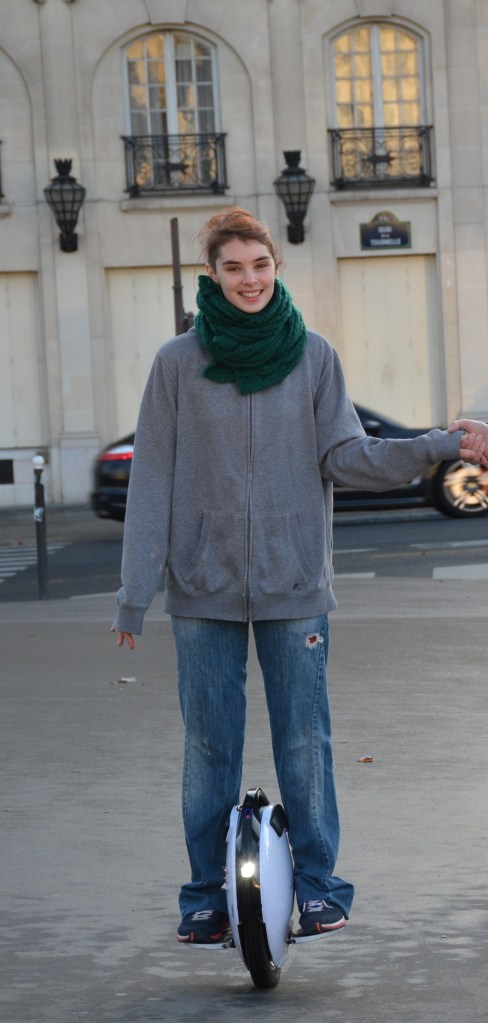
Around 2010, the serial inventor Shane Chen, based in Portland, came up with what he called a ‘gyro-stabilised “People Mover”’. The first Solowheel was born. This wheel is one of the numerous urban micro-mobility devices that emerged since the 2000s. Chronologically, the Segway is considered to be the first of this category: it is big, unpractical to carry and to handle, that is why ‘in the long run, it was just adopted by mall cops and sightseeing groups’.
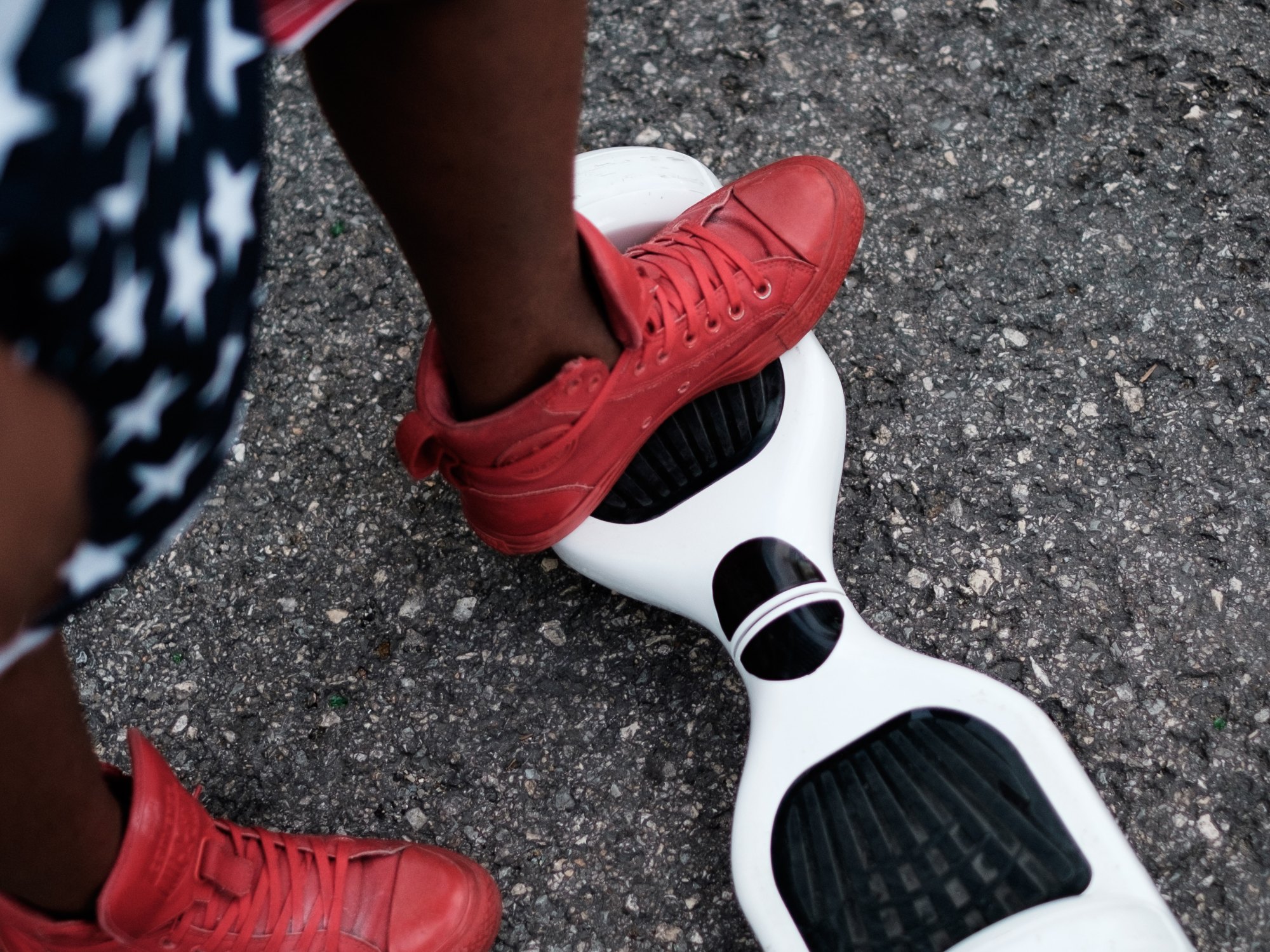
2015 was the year of the hover board/smart board (an invention that made Back to the Future’s fans quite happy), a two-wheeled board that uses the same gyroscope principle as the unicycle (users can move forward and backward or turn left and right by leaning their bodies a little in the desired direction). 2016 saw another invention, the Surfwheel, a one wheeled skate-board, and these devices are going to keep on developing.
No matter if you can see yourself riding one or not, self-balancing scooters have taken the world by storm and are becoming quite the trend.
Sam Brook, on self-balancing scooters in 2015
This short video realized by the French program FutureMag, explains the mechanism quite well.
Electric micro-mobility is so new that laws are still blurry about it. In France for example, one can use a wheel on the sidewalk (at a maximum of 6 km/h) and the bike lines (at a maximum of 25 km/h), not on the street, neither in parks.
Why is this transportation device so successful?
People use it for different reasons: going to work, mixing it with public transportation (the wheel is light and small enough to be carried in the metro or the bus) and running errands … It replaces the bike while being faster and easier to carry.
The eco-friendly side is important in the advertising of the product: the wheel – and electric transportation devices in general – does not leave a carbon print, and goes up to 25km/h average. One can ride it for 60 kms with a full battery.
However, I think there are limitations: to be truly eco-friendly, the electricity used must come from a source respectful of the environment.
Let’s not forget the economical aspect of it: even though the average price ranges between 500 and 1500 euros, it is cheaper than a motorcycle, and there is no cost of fuel. The battery needs to be replaced every five years or so.
Finally, the look!
To become a trend, a device not only needs to be efficient, but to look good and modern. A lot has being put on the aesthetic of the wheels, some are more minimalistic (white or black, and classy), some more extravagant (full of colored neon), and some possess integrated speakers to play music. Most of the more recent ones connect to a smartphone app, which adds to their contemporary appeal.
Each time an innovation starts to spread around the world, a group of fans appears. As Benson Ang writes in Straits Times, ‘The growing number of electric unicyclists has also led to the formation of an interest group, The Wheelies’. These wheels enthusiasts enjoy going to ‘unicycle outings’ with other adepts, as one can see in the Youtube Channel ‘Chionging with the Wheelies!’
Who buys wheels? Everyone?
People from most generations seem to have an interest in using electric self-balancing unicycles. Even though the time it takes to learn how to master the device might differ whether you are younger or older (it takes from 30 minutes to a month), people who are 60 years-old and more ride them.
Considering the price range of a wheel, it is most likely used by middle and upper classes. It is an investment, and a quite expensive gift. When it comes to gender, very few women buy wheels, 3% of the customer according to the salesman in a shop I have been to.
People who live accelerated lives.
A thought that I have is that the development of such innovations will contribute to the acceleration of the urban time. On one hand, it feels like people will stop taking the time to appreciate the environment they evolve in. On the other hand, this is inevitable and inventing new devices to adapt to this acceleration is essential. Urban spaces’ rhythm has become incredibly faster in the past century.
Electric micro-mobility devices allow delivery companies to respond quickly to a faster demand. At a time where efficiency in trips is at the forefront, electric unicycles could be more than a trend and could impose themselves in the lasting transportation market. These two categories of customers – people who embrace the acceleration of urban time and the professional world that answers to this developing market – might become the most important targets for ECU’s producers in the near future.
Let us not forget about sporty people, always looking for new experiences. Enthusiasts who have already mastered the wheel to go from a point A to a point B can push it further, and try it on one foot, or invent acrobatic moves. Watch a performance here!
I am convinced that soon, there will be shows mixing dancing and electric unicycling, just like those that already exist with drones. Multimedia shows are more and more developed and micro-mobility is finding its place among them.
It would be interesting to see how riding a unicycle is a way to express one’s presence in urban spaces. Indeed, the sound systems on some electric unicycles could cover a whole street. Some customers make the most of it, making sure they are heard wherever they roll, imposing their music tastes on passers by. ‘Uniwheel certainly embraces this, with the product’s website describing it as an «urban head-turner,».’ Who knows? Soon we might find quizzes on the internet saying ‘tell us which brand of unicycle you own and we will tell you who you are’.
I am curious to know what the law will do about the sound system issue. There might be a whole field of law that will be developed as urban transportation evolves.
That being said, I am sure users will come up with inventive ways to use the
sound part: it could be convenient for advertising, or making oneself heard during a protest, but these are just ideas that crossed my mind and have not being acted upon yet.
We have yet to see what the evolution of this trend will be
Will ECUs be forgotten in a year or two, or will people around the world choose this option as one of their favorite transportation devices ?
Everyday researchers are working on new technologies in the field of urban transportation, they might be close to bringing to the market what a lot of customers have been waiting for: a flying device that could carry human beings in urban areas, exo-squeletton devices that allow people to walk faster… All of these concepts will transform the way people move in urban spaces and it is exciting.
To know if the use of ECUs will last and will not just be a fad, we will have to wait some time. If the spread of electric micro-mobility inventions grows, populations will have to adapt and reinvent the way they navigate. I wonder if people on electric wheels will still get to experience the feeling of wandering around city streets with no specific goal.
 Impawtent Content