I have been inspired to write this article after having taken a course on Eco-design for Cities and Suburbs at the University of British Columbia (taught by Larry Beasley and Jonathan Barnett). Check out their book!
When travelling between Portland, Seattle and Vancouver (BC), I was amazed by the beauty of the American Northwest’s landscapes. I believe that eco-design – alongside the implementation of renewable energies – is one of the ways to preserve them. This essay will focus on how ways of turning existing aspects of a city into something new and sustainable are incorporated in the design of Portland, OR.
Despite the multiple environmental disasters caused by climate change in the past few years, which make our current urban growth models increasingly obsolete, and a federal government that seems to be maintaining these models, I have chosen a positive approach for this paper. Experts on environmental, urban and social sciences, as well as concerned citizens, are advocating for changes in urban planning, and some cities – such as Portland and Vancouver – have already adopted smarter design policies.
For example, recycling and reusing should always be prioritized upon disposal of waste. This is especially true when it comes to urban design, since current building initiatives are making urban environments more wasteful of open land. City planners focus on the expansion of urban areas, which is easier than thinking of how they could incorporate existing and obsolete buildings in new projects. Existing urban policies and abandoned buildings can be re-imagined to transform landscapes into smarter and more environmentally sustainable cities.
Why do environmentally respectful urban policies need to be implemented?
Primarily because of climate change, which is causing an increase in flooding, wildfires and soon, changes in our food supply.
Secondarily, we need to think in terms of ‘‘balancing transportation.’’ Traffic congestion on US highways has been rising since 2005, and will soon cause our car system to stop functioning effectively. That being said, people are not ready to let go of their cars, which is why we need to find smarter ways of transportation. For example improving the railroad system. In Paris where I am currently living, the mayor proposed a plan saying that non-electric cars will not be tolerated inside the city from 2030 onward. This measure might seem extreme, but is widely supported. I am convinced that, with the right information and the citizen’s involvement, we will manage to make Paris more sustainable.
Societies need to be conscious of our constantly growing population and adapt to it, while respecting the environment, so that future generations will be able to enjoy the place they grow up in. Most cities are not there yet, following a growth model that leads to loss of open lands, instability of the water supply, and traffic congestion.
[Eco-design means] creating a synthesized, holistic strategy for cities and suburbs.
Larry Beasley
In other words, preserving the environment whilst fulfilling the needs of people in terms of urban design.
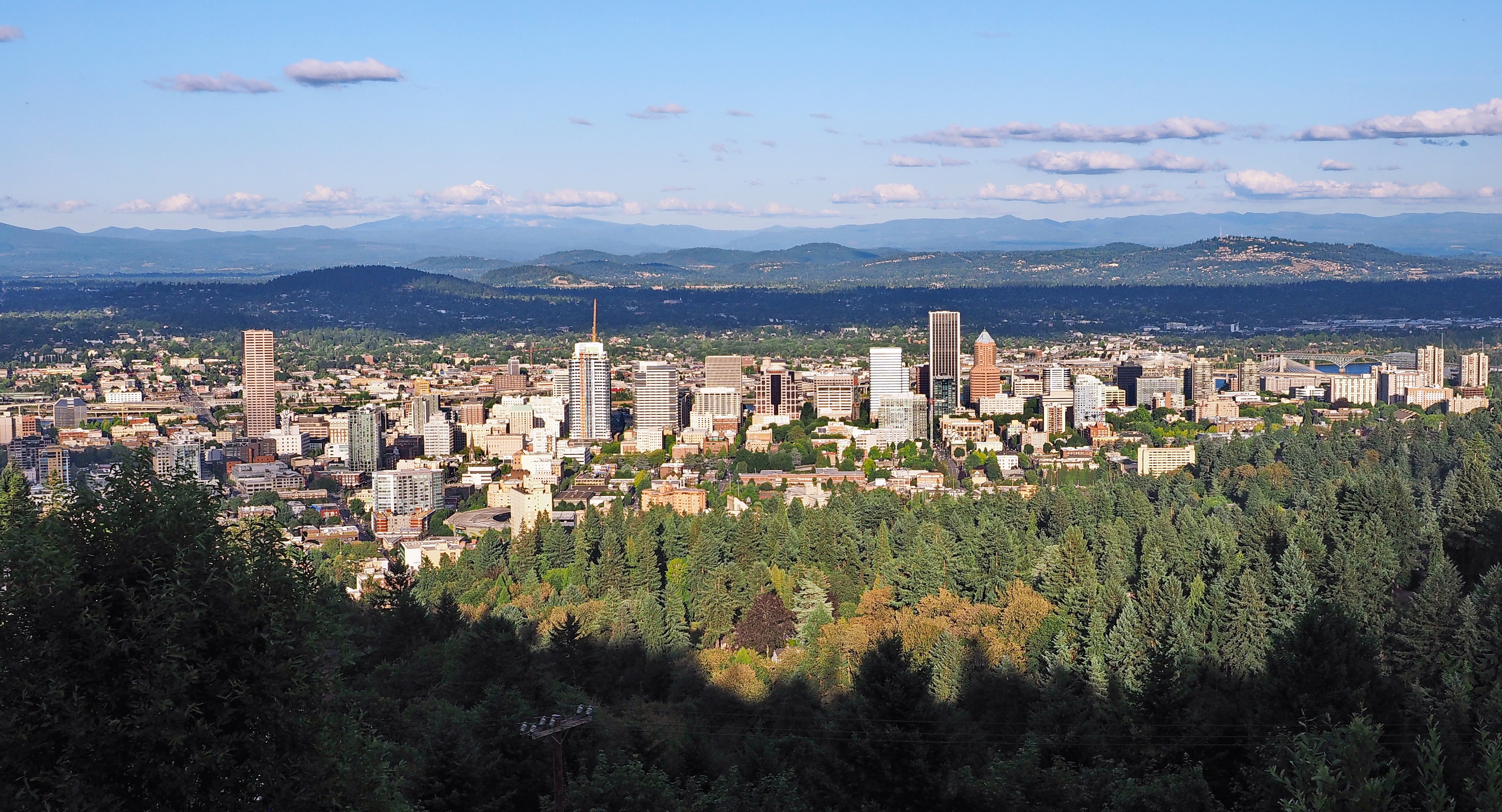
Let’s see how Portland, OR, constitutes a pioneer city in terms of eco-design
In addition to remaining “weird” as its citizens value, Portland continues to grow in livability, where pedestrian paths and green areas multiply.
The revitalization strategy of Downtown Portland dates back to the 1970s, when the inner city found itself in competition with suburban centers. The original concept was to make downtown more accessible, attractive and diverse to stop the spread of suburbs. Portland designers tried to adapt to the growing job base and population. Their project was to mix workplaces and homes in the inner city, following the model of Vancouver, BC. In addition, it was decided that the city should be more sustainable. Its model would soon be known as Portlandia.
In 1979, the first Metropolitan Growth Boundary policy in North America was implemented in Portland, to face the problem of the numerous suburbans centers that emerged at the time, attracting the population outside of the inner city.
In 1969, a public transportation company – TriMet – was created. Then, the Metropolitan Area Express created four light-rail lines to connect Downtown to the suburbs. City planners managed the complexity created by the suburbs with concrete and sustainable solutions. In addition to the improved public transit, focus was put on bicycle lanes and walking routes. By 2017, 13% of commuters were traveling via transit, and 8% cycled to work. These numbers have been continually growing.
Portland has what Beasley calls ‘one of the most elegant and persuasive street-scaping programs in North America, focusing on landscaping and hard-scaping of sidewalks […], creating a comfortable, safe, and fascinating setting for walking and for relaxing.’ Portland feels safe to walk in, and is beautiful as well with its street art, shaded green spaces and water play features. In other words, it is a “human public environment.”
Portland’s design prioritizes reusing and transforming over creating. Old buildings have been restored. City planners switched their focus from driveways to walkways. In the 1970s, Harbor Drive was replaced by Tom McCall Waterfront Park along the Wilamette River shoreline. In the 1990s, most of the Lovejoy Viaduct was replaced by a residential area. As a result, the need for workers to develop workplaces and housing increased. These initiatives brought people back to the inner city, revitalizing it.
In the 1990s, the old railroads and obsolete warehouses of the Northwest Industrial Triangle and the space left by the destruction of the Lovejoy Viaduct were re-imagined to give birth to a brand new development project: the Pearl District. Housing, offices, parks, walkways and modern mid-rise buildings were built there. Approximately 6,000 people moved to this primarily rental part of the city. The same process happened in what is now known as the South Waterfront District. What was originally an old industrial area turned into a high rise and townhouse part of Portland, in which over 5,000 people live. This area calls itself an eco-district because of its sustainability measures and green construction. The Mirabella, one of the South Waterfront District’s towers, received a platinum certification under Leadership and Energy in Environmental Design in 2010.
Presently, over 40,000 people live in the central neighborhoods of Portland thanks to a smart use of ecodesign in the city, and this number grows at a steady pace. The city still has to face issues such as homelessness and a lack of services in some neighborhoods, but if city planners hang on to this positive development approach, Portland has the potential to become a fully sustainable city in the future.
 Impawtent Content